
For homes
We repair gutters on single-family homes and small multi-unit buildings across Bell Gardens. You get photos of what failed and a hose test before we pack up.
- Water behind the gutter
- Sagging run holding water
- Downspout at the foundation
Gutter failure in Bell Gardens usually shows up as overflow in a winter storm, a drip at a joint, or a section pulling away from the fascia. The cause is often simple — a failed hanger, a blocked downspout, a joint that has opened — but the damage it causes, water backing under the eave, is not.
 Check the fallProbe the fasciaHose test the run
A gutter that overflows in heavy rain is not necessarily undersized. It may be blocked, pitched wrong, or fed by a valley that concentrates water into one short run. Repair should find which of those it is.
What this service covers here: Hanger, joint and seam repair; Downspout clearing and refitting; Fascia repair where a gutter has pulled away and damaged the board.
Gutter repair is for overflow, drips, sagging sections, separated joints, and gutters that have pulled away from the fascia.
Every gutter repair call includes the inspection, the repair work and a water test. Here is what is standard on a Zornex Key Roofers visit, and what we price separately if the job turns out to need it.
We walk the entire gutter line, check the fall with a level, and probe the fascia behind the run. You get photos of every failed joint, sag or rust-through we find, whether or not it is part of today's repair.
Failed seams get cleaned to bare metal, primed and sealed with a urethane gutter sealant that stays flexible through Bell Gardens heat. That flexibility is what keeps the joint closed when the metal expands in July.
Wallow-out spike holes get new hangers, and we reset the fall so water moves toward the downspout. A run with no pitch is the most common cause of standing water we find on older Bell Gardens homes.
We resecure separated downspouts, clear the elbow, and extend discharge away from the foundation. A downspout that empties against the wall undoes every other repair on the run.
We run a hose at the high end and watch the water travel before we leave. Then we sweep with a nail magnet, bag the old material, and walk the run with you so you see it working.
The approach is the same for a home and a business. What changes is the access, the schedule and who needs the paperwork.
We repair gutters on single-family homes and small multi-unit buildings across Bell Gardens. You get photos of what failed and a hose test before we pack up.
We handle drainage runs on flat commercial roofs and small retail buildings. Property managers get before-and-after photos they can pass along to the owner.
A plain-language look at what Gutter Repair involves and when it is needed.
See how it worksGutter repair Bell Gardens CA is the trade of restoring a roof drainage system that has failed at a seam, hanger, end cap or downspout, rather than replacing the whole run. On a typical Bell Gardens bungalow we pull the failed section, clean the channel, re-seal joints with a urethane gutter sealant, replace rusted hangers, and set the correct fall so water moves toward the downspout instead of pooling. Small jobs are quick; a full re-pitch across a long run takes longer.
Bell Gardens sits in a warm, dry pocket of Los Angeles County, so gutters here rarely rot from constant rain. They fail from heat cycling, tree branch damage and years of debris. Original 1950s homes near Garfield Avenue Corridor often still carry their first galvanized run, and that metal has usually rusted through at the bottom seam. If you have been searching gutter repair near me Bell Gardens and finding nothing but roofers who want to sell you a whole new roof, we do the drainage work itself.
A gutter that drains correctly keeps water away from the fascia, the roof edge and the foundation.
Five steps, no surprises. Here is exactly what happens from the first phone call to the final walk-around.
You describe what you are seeing: a drip at a seam, water running behind the gutter, a downspout that empties onto the walkway. We ask the age of the house and whether the run is galvanized or aluminum. That tells us whether to load sealant and hangers or a full replacement section before we roll.
We walk the perimeter, check the fall with a level, and probe the fascia behind the gutter with a pry bar. If the wood is soft, we tell you before we quote. You get photos of every failed joint and a written scope with the price on it. Most inspections take 20 to 30 minutes.
We set the roofing ladder, tie off, and pull the damaged section. Seams get cleaned and resealed, hangers get replaced with new spikes or hidden brackets, and rusted runs get cut out and spliced with matching material. A standard repair takes two to four hours.
Before we pack up, we run a hose at the high end of the run and watch the water travel. If it pools anywhere, we adjust the pitch on the spot. You see the system working with your own eyes, not just our word for it.
We sweep the ground with a nail magnet, bag the old metal, and walk the run with you. You get a short note on what we fixed and what to watch. If we found something that needs a roofer, we tell you straight instead of upselling on the spot.
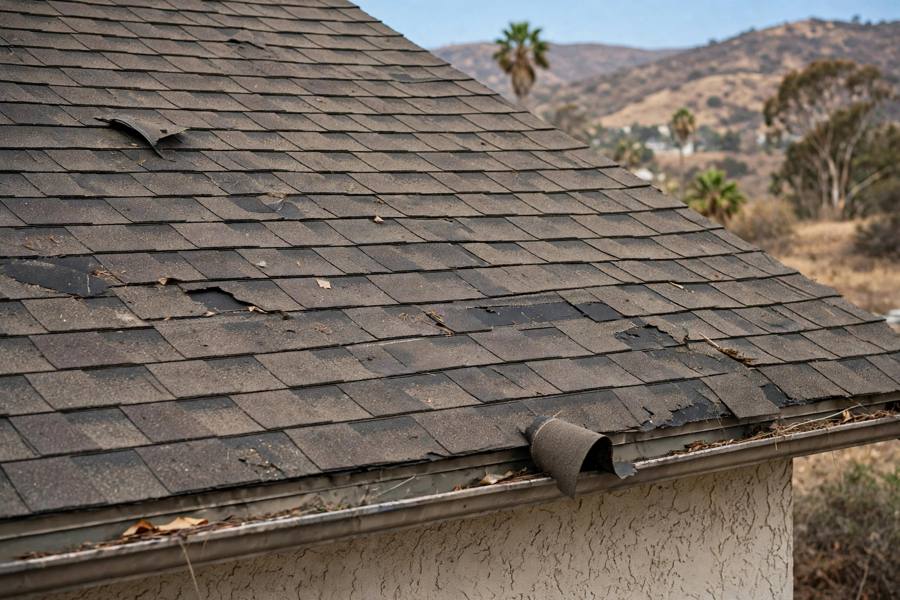
Move across a circle, or focus it and press Enter, for an illustrative thermal view of the photograph.
Gutter work happens at the roof edge, which is the least forgiving place on the house. We set the ladder on stable ground and tie off before touching the run.
The pry bar opens the gutter away from the fascia so we can see the wood behind it. Tin snips cut the rusted or damaged section cleanly so the splice fits tight.
We snap a chalk line along the run and check the fall with a level. That is how we set the pitch so water actually reaches the downspout instead of pooling mid-run.
Seams get cleaned, primed and sealed with a flexible urethane sealant. It stays elastic through the heat cycling that opens up rigid sealants within a season.
Wallow-out spike holes get new hidden hangers driven into solid fascia. We drill fresh holes rather than reusing the failed ones, which is why our re-hangs hold.
Thermal views are illustrative, generated from the photographs.
Every gutter call ends with a sweep of the ground below. Old hangers and fasteners end up in the grass, and a tire does not care whose they are.
We set the run at roughly 1/16 inch of fall per foot toward the downspout. That is enough to move water in a light rain without making the gutter look crooked from the street. Most sagging gutters we see have lost this fall entirely.
Rusted sections get cut out and replaced with the same profile and gauge as the existing run. Mixing a 5-inch K-style section into a 4-inch channel creates a joint that leaks. Matching material is the only way the splice holds.
While we are at the edge, we check the drip edge and the first course of underlayment. Water that backs up under the roof edge looks like a gutter leak but is not. Catching it now saves a roof repair later.
We run water at the high end of the run and watch it travel to the downspout. Any pooling means the pitch is off and we adjust on the spot. You see the system working before we pack the truck.
A storm just passed and water is sheeting off the roof corner onto the walkway.
We treat this as an active leak and prioritize it. The crew checks the gutter hangers and seam at that corner, resecures the run, and confirms the downspout is clear. If the drip edge above the gutter is also lifted, we note it for a roof repair.
Outcome: Water goes back into the gutter and down the downspout instead of onto your walkway.
You noticed a brown stain on the stucco below the gutter line after the last rain.
That stain usually means a seam has been weeping for a while. We inspect the full run, find the failed joint, clean it to bare metal and reseal it. We also check the fascia behind it for soft wood.
Outcome: The drip stops and the stucco has a chance to dry out. If the wood behind it is sound, no fascia work is needed.
The gutter is visibly sagging and holding water weeks after the last rain.
We pull the standing water, replace the wallowed-out hangers, and reset the pitch across the run. If debris caused the sag, we clear the channel and flush the downspout while we are up there.
Outcome: The run sits level and drains fully after a storm. Standing water and the mosquitoes that come with it are gone.
You are selling the house and the buyer's inspector flagged the gutters.
We inspect the flagged runs, document what is actually failing versus what is just age, and repair the real defects. You get photos and a short written note you can hand to the buyer's agent.
Outcome: The flagged items are repaired and documented, which keeps the drainage issue from becoming a negotiation point at closing.
Bell Gardens sits in a warm, dry pocket of Los Angeles County, so our gutter problems look different from what you would see on the coast. We do not fight constant rain rot. We fight heat cycling, tree debris and decades-old galvanized metal. Summer temperatures push aluminum through an expansion and contraction cycle that wallows out spike holes until the run sags.
Sycamore and ficus branches drop debris that clogs the channel and adds weight. On the 1950s housing stock near the Gage Avenue Corridor, the original galvanized runs have usually rusted through at the bottom seam. When you call for gutter fixing services Bell Gardens California, that is the context we are working in.
We carry matching splice material, new hangers and flexible sealant on the truck so most repairs finish in one visit rather than two.
Before: A 52-foot aluminum run had lost its pitch and held two inches of standing water weeks after the last rain. Four hangers had pulled out of the fascia, and the wood behind two of them was soft enough to push a screwdriver into.
After: We replaced the rotted fascia section, installed six new hidden hangers, and reset the fall at 1/16 inch per foot. The hose test showed water reaching the downspout in under 30 seconds with no pooling.
Clear the channel each fall before the first storm. With the new hangers and correct pitch, a twice-a-year check is enough to keep it draining.
Before: An original galvanized run on a 1950s bungalow had rusted through at the bottom seam over an 18-foot stretch. Water dripped constantly onto the stucco and left a brown stain down the wall.
After: We cut out the rusted 18 feet and spliced in matching galvanized material with sealed joints. The stain stopped spreading and the run held water through the next two storms without a drip.
Keep debris out of the channel so moisture does not sit against the remaining original metal. The un-spliced sections are older, so check them each spring.
Before: A downspout emptied directly against the foundation wall, and the crawlspace showed damp soil after every storm. The elbow was also packed with debris, so water backed up the run and overflowed at the top.
After: We cleared the elbow, resecured the downspout and added an extension that discharges 5 feet from the wall. The crawlspace dried out over the following weeks and the run stopped overflowing.
Check the extension each fall and clear the elbow if you see water backing up. A 5-foot discharge line is the cheapest foundation protection there is.
These are the calls we get most often, and each one has a different fix. Knowing which one you have is the difference between a repair that holds and one that fails by spring.
A repaired gutter moves water off the roof and away from the house.
Water that overflows a clogged or broken gutter soaks the fascia board behind it. Once that wood softens, the gutter hangers pull loose and the run drops. We fix the drainage first, then sister in new fascia where needed, so the repair holds instead of sagging again within a season.
A single misaligned downspout can dump 500 gallons against your slab during one October storm. We extend discharge 4 to 6 feet from the wall and re-pitch the run so water leaves the footprint. That is the difference between a dry crawlspace and a cracked slab.
Standing water at the gutter line backs up under the drip edge and rots the first course of roof underlayment. Repairing the channel keeps that edge dry. It is far cheaper than replacing sheathing, and it protects the architectural shingles you already paid for.
Standing water in a sagging gutter is a breeding site. In Bell Gardens, that means mosquitoes in summer and roof rats using the channel as a highway. Clearing and re-pitching the run removes the water they need, which is the only fix that lasts longer than a week.
Clear records you can keep and share.
Images of each failed joint and hanger
Short written summary of the repair
Note that the run was hose tested
What to watch and when to check
Most gutter failures are local, not whole-run. The section that failed tells you which fix applies.
A local failure on a run that is otherwise sound
Damage across a third of the run
The run has failed along most of its length
Bell Gardens, CA 90201. Not listed? Call and ask: it only takes a minute.
Based in Bell Gardens. Pick a pocket for local details.
A single resealed seam or re-hung section sits at the low end. A 40-to-60-foot re-pitch with new hangers and a downspout replacement lands at the high end. Fascia rot behind the gutter adds to the total because the wood has to be replaced before the gutter can be re-hung.
Zornex Key Roofers handles gutter repair, gutter installation and downspout work across Bell Gardens and Los Angeles County. We are a roofing crew, so we also check the drip edge and roof edge while we are up there. That matters when the real leak is at the flashing and not the gutter itself. Call us and we will tell you which one it is.
Heat cycling, tree branch damage and debris are the three big ones here. Summer temperatures expand and contract aluminum until the spike holes wallow out and the run sags. Sycamore and ficus branches drop debris that clogs the channel. On older homes, the original galvanized steel simply rusts through at the bottom seam after decades of service. None of that is a roof failure.
Other services from the same team.
Water running behind your gutter will not fix itself, and the fascia rot it causes costs far more than the repair. Call (424) 336-0888 and describe what you are seeing.
Call us at +14243360888 — we are open 24 hours, every day. Tell us what you are seeing and we will bring the right tools.