
For Homes
We install roofs on single-family homes and duplexes across Bell Gardens. You get a written scope, a start date, and a crew that cleans up daily.
- Aging 3-tab shingles
- Ceiling stains after rain
- Shingles in the yard
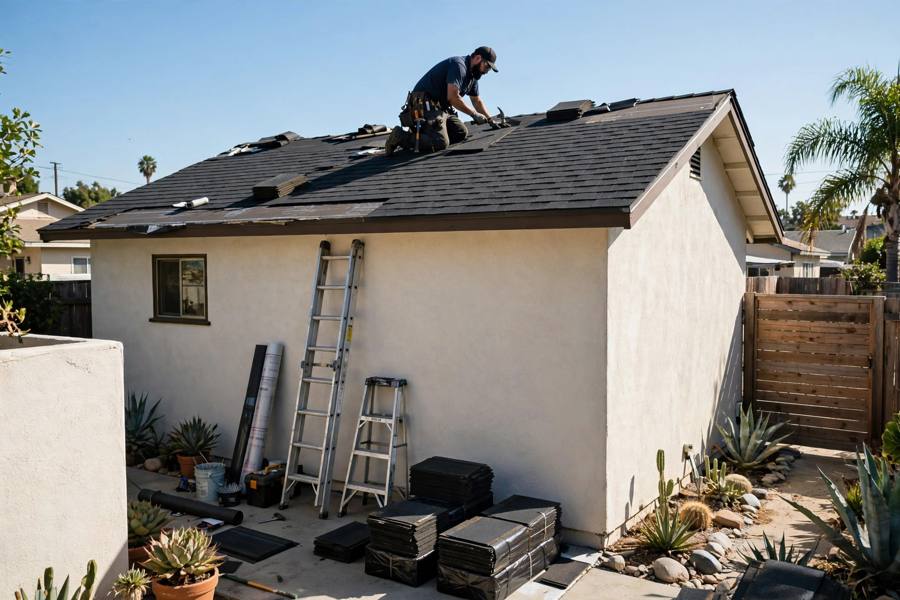
A new roof in Bell Gardens is rarely a blank-slate job. Most homes here were built in the 1940s to 1960s, on small lots, and a new installation usually means taking off tired layers, checking a deck that has seen sixty summers, and building the system back up so the next roof lasts through heat, UV and concentrated winter rain.
 Deck inspectionFlashing detailYard sweep
On a small lot there is nowhere to hide a mess. Materials, a dumpster and a crew have to be staged so neighbours can still get past and the yard is swept at the end of each day. That staging question — not just the material choice — is what separates a smooth Bell Gardens installation from a disruptive one.
What this service covers here: Full tear-off and deck check before anything new goes on; Underlayment, flashing and drip edge fitted to the roof's pitch; Steep-slope finish for the main house and a separate detail for a low-slope rear addition.
You are choosing installation when the roof has reached the end of its service life, when repairs keep returning to the same places, or when a second layer has already been added and there is nothing sound left to patch over.
A complete install covers tear-off, deck inspection, underlayment, flashing, ventilation, and the finished roof surface. Add-ons like skylight replacement, gutter work, or fascia repair are quoted separately once we see the condition of the wood. Here is what is standard on every job we run in Bell Gardens.
We strip every layer of old roofing down to the deck, load it into the dumpster, and haul it off. Landscaping and driveways get tarped first, and we run a nail magnet sweeper across the yard before we leave.
Every board gets checked for rot, delamination, and soft spots. We replace what is failing with matching sheathing so the new roof has a solid substrate and the fasteners actually hold.
Ice and water shield goes along the eaves, valleys, and penetrations, with roofing felt or synthetic underlayment across the field. This is the layer that keeps water out when wind drives rain sideways under a shingle.
New flashing at the chimney, walls, skylights, and vent boots, plus drip edge along the rake and eaves. Fresh flashing is the difference between a roof that lasts and one that leaks at year three.
We size intake and exhaust vents to your attic square footage so hot air escapes instead of cooking the deck. Proper balance protects the shingles and drops summer cooling costs.
We handle any required permit and schedule any required inspection, and meet the inspector on site. You get the signed-off paperwork for your records, which matters when you sell the house.
The approach is the same for a home and a business. What changes is the access, the schedule and who needs the paperwork.
We install roofs on single-family homes and duplexes across Bell Gardens. You get a written scope, a start date, and a crew that cleans up daily.
We install flat and low-slope systems for retail, warehouse, and multi-unit buildings. Work is scheduled around your operating hours.
A plain-language look at what Roof Installation involves and when it is needed.
See how it worksRoof installation Bell Gardens CA is the full tear-off and rebuild of your roof system, not a patch job. We strip the old shingles or membrane down to the deck, replace any rotted sheathing, then layer ice and water shield along the valleys and eaves, roofing felt or synthetic underlayment across the field, new flashing, drip edge, and finally the shingles or panels themselves. Every nail goes in with a roofing nail gun at the right depth and pattern so the manufacturer's wind rating holds up. We finish with ridge caps, vents, and a nail magnet sweeper pass across the yard.
Most Bell Gardens homes were built between the 1940s and 1970s, so we run into a lot of dried-out 3-tab shingles, cracked flashing, and fascia rot hiding behind gutters. Summer heat pushes attic temperatures past 140 degrees, which cooks underlayment and shortens roof life fast. If you have been searching for new roofing installation near me Bell Gardens, the honest answer is that a 20-year-old roof in this climate is already on borrowed time. We serve Bell Gardens, CA 90201, so we know what these roofs look like underneath.
A roof is only as good as the deck, flashing, and ventilation underneath it.
You get a written scope, a start date, and a crew that shows up when we say we will. Here is the sequence from first call to final walkthrough.
You pick the color and grade, and we confirm underlayment, flashing, and ventilation specs. Most homeowners land on architectural shingles for the balance of cost and lifespan.
The crew lays tarps over landscaping and drives, then strips the old roof with shingle rippers and pry bars. We inspect the deck board by board and replace any rot or delamination. A typical 1,800-square-foot ranch takes one to two days to strip and re-deck.
Ice and water shield goes in at the eaves and valleys, then underlayment, drip edge, and flashing. Shingles go down in staggered courses with a roofing nail gun, and we cut hips and ridges with tin snips and a circular saw. Chimney, skylight, and vent boots get sealed with fresh flashing and caulking gun beads.
We run a nail magnet sweeper across the yard and driveway, haul off all debris, and walk the roof with you. The whole job usually wraps in three to five days depending on size and pitch.
Move across a circle, or focus it and press Enter, for an illustrative thermal view of the photograph.
Hand-nailing a full roof is slower and inconsistent on depth.
Strips old shingles and lifts flashing without damaging the deck underneath. Clean tear-off is the first step to a flat, well-fastened new roof.
Snaps straight course lines across the roof and cuts flashing and metal trim to fit. Straight courses are what make a finished roof look professional.
Keeps crews secured on steep pitches and provides stable access to the roof edge. Fall protection is non-negotiable on every job.
Picks up stray nails from the yard, driveway, and landscaping after tear-off. It is the last thing we run before we pull out of your driveway.
Thermal views are illustrative, generated from the photographs.
Seals flashing terminations and drives fasteners at vents, boots, and skylights. These are the details that keep small penetrations watertight.
We follow the published nailing schedule for each shingle line, typically four to six nails per shingle depending on wind zone.
Self-adhered membrane goes along the eaves, valleys, and around every penetration before the field underlayment. It is the backup layer that catches water when wind drives rain sideways under a shingle.
We calculate intake and exhaust vent area against the attic square footage so hot air escapes instead of cooking the deck. Balanced ventilation extends shingle life and drops summer cooling load.
Every chimney, wall, and skylight gets new flashing installed to California code, not reused or patched. Flashing failure is the most common source of leaks we find on roofs under 15 years old.
A 1960s ranch home with three layers of shingles and a leak over the back bedroom.
We strip all three layers, replace two rotted deck boards, install ice and water shield at the valleys, and lay new architectural shingles with fresh flashing at the chimney and vents.
Outcome: The leak stops, the attic stays dry through the rainy season, and the home passes a pre-sale inspection without roof objections.
A duplex owner needs the roof replaced between tenants with minimal vacancy time.
We schedule the tear-off and install in a four-day window, handle any required permit and inspection so the owner does not have to be on site. Flat carport section gets TPO while the pitched section gets shingles.
A homeowner finds shingles in the yard after a windstorm and a leak at the chimney.
We tarp the roof the same afternoon, photograph the damage for the insurance claim, and return within the week for a full replacement with new flashing and ridge caps.
Outcome: The insurance claim is documented properly, the roof is restored to pre-storm condition, and the homeowner avoids interior water damage.
A Spanish tile roof from the 1970s is intact on top but leaking underneath.
We lift the tile, replace the failed underlayment and battens, re-flash the valleys, and reinstall the original tile where it is still sound, sourcing matching pieces for broken ones.
Outcome: The roof keeps its original look, the leak is gone, and the homeowner avoids the cost of a full tile replacement.
A commercial building with a flat roof has ponding water and seam failures.
We install tapered insulation to correct the slope, then lay a heat-welded TPO membrane with new terminations and scupper details.
Bell Gardens sits in Los Angeles County with hot, dry summers and a short but intense rainy season, so roofs here take a beating from UV first and water second. The housing stock is mostly mid-century, which means shallow pitches, 3-tab shingles past their prime, and fascia that has been quietly rotting behind gutters for years.
We see a lot of flashing failure at chimney chases and vent boots, plus ponding water on flat carport and addition roofs. Summer attic temps push past 140 degrees, which cooks underlayment and shortens roof life, so we size ventilation carefully on every install.
If you are looking for roof installation services in Bell Gardens CA 90201, we handle any required permit, meet the inspector, and build to California code on fastening, ventilation, and flashing. We also work in Bell Gardens, CA 90201, and we know which streets have the older decks that need extra sheathing work before the new roof goes on.
Before: A 1,600-square-foot ranch home had three layers of shingles, a leak over the back bedroom, and two soft deck boards near the valley. The homeowner had patched the ceiling twice.
After: We stripped all three layers, replaced the deck boards, installed ice and water shield at the valleys, and laid new architectural shingles with fresh chimney flashing. The leak stopped and the ceiling stain has not returned.
Annual gutter cleaning and a tune-up every two years keeps debris out of the valleys and reseals any flashing that works loose.
Before: A 1970s Spanish tile roof looked fine from the street but leaked at the valleys. The underlayment underneath had failed, and the homeowner was quoted for a full tile replacement.
After: We lifted the tile, replaced the underlayment and battens, re-flashed the valleys, and reinstalled the original tile with matching replacements for broken pieces. The roof kept its look at a fraction of full replacement cost.
We check the valleys and flashings once a year and replace any cracked tiles before water gets underneath them.
Before: A detached carport roof held standing water after every rain, and the seams had started to separate. The owner was worried about the structure and the water dripping onto the driveway.
After: We added tapered insulation to correct the slope, installed a heat-welded TPO membrane, and rebuilt the terminations and scupper details. Water now drains within an hour of a storm.
Twice-a-year checks of the scuppers and seams keep the membrane clean and catch any debris before it blocks drainage.
Most roof failures start small and stay hidden until water is already inside the house. These are the issues we see most often on Bell Gardens roofs and how we handle them.
A roof is the one part of your house that takes every bit of sun, rain, and wind without a break. Replacing it on your schedule beats replacing it after a leak ruins drywall and insulation.
One missed flashing failure can push water into your attic for months before you see a ceiling stain. We seal every penetration, valley, and chimney chase during installation, then water-test the trouble spots.
A new roof with proper intake and exhaust ventilation drops attic temps by 20 to 30 degrees on a 95-degree Bell Gardens afternoon. That means your AC runs shorter cycles and your energy bill drops. We size ridge vents and soffit vents to the square footage of your attic, not to whatever box was on the truck.
Cheap installs with too few nails or high nails void that coverage.
A roof with 5 years left scares buyers and kills offers. In the Bell Gardens market, a documented roof replacement routinely returns 60 to 70 percent of its cost at sale, and it makes the home easier to insure.
Clear records you can keep and share.
Materials, steps, and timeline in writing
Before, during, and after images
Signed-off inspection paperwork
Every job carries general liability insurance and workers compensation coverage.
OSHA 10 and OSHA 30 trained crews for ladder, staging, and fall protection
Flat roof work in Firestone Building Products and Carlisle SynTec membranes
Bell Gardens, CA 90201. Not listed? Call and ask: it only takes a minute.
Based in Bell Gardens. Pick a pocket for local details.
Architectural shingles land at the lower end; tile and standing seam metal push toward the top. Flat sections with TPO or modified bitumen are priced separately.
Most homes typically take three to five working days from tear-off to final walkthrough. A simple 1,500-square-foot ranch with architectural shingles can finish in three days. Larger homes, steep pitches, or tile and metal systems stretch to seven to ten days. Weather can add a day, but we tarp the deck at the end of every workday so the house stays dry overnight.
Call Zornex Key Roofers to discuss your roof and arrange an inspection.
They handle the summer heat and UV load well and carry 110 to 130 mph wind ratings when nailed to spec. Concrete tile lasts longer but adds structural weight. Standing seam metal is the premium pick for homeowners staying put 30-plus years.
Other services from the same team.
One call starts the whole process.
Call us at +14243360888 — we are open 24 hours, every day. Tell us what you are seeing and we will bring the right tools.